Quick answer · 짧은 답
Every joint in the spine has its own normal angle. Reading an X-ray means measuring each joint and finding the one that has moved away from it, then showing you that joint on the same screen.
척추의 관절마다 고유한 정상 각도가 있습니다. 엑스레이를 읽는다는 건 마디마다 각도를 측정해 그 각도에서 벗어난 관절을 찾고, 같은 화면에서 그 관절을 보여 드리는 일입니다.
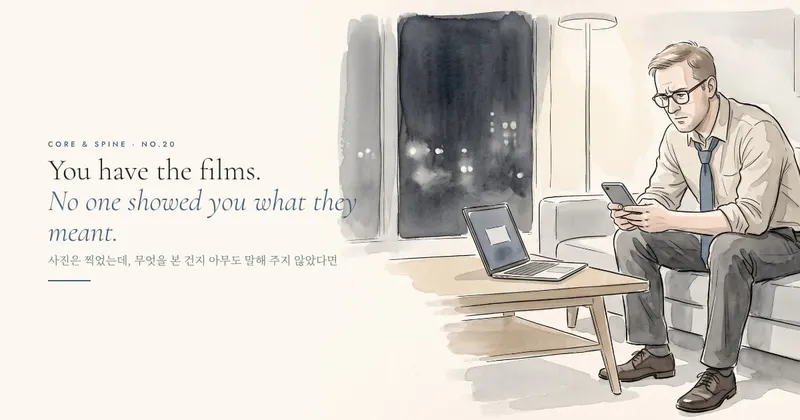
He is forty, works at a desk all day, and his neck has been stiff for months. He had X-rays taken a while back. When we ask what they showed, he shrugs. "Some wear, I think."
마흔, 하루 종일 책상 앞에서 일하고, 목은 몇 달째 뻣뻣합니다. 얼마 전에 엑스레이도 찍었습니다. 뭐가 나왔냐고 여쭤보면 어깨를 으쓱합니다. "좀 닳았다던가요."
We meet this often. The films exist; the explanation does not. Knowing what is on a film isn't a patient's job. Showing it is ours.
자주 있는 일입니다. 사진은 있는데 설명이 없습니다. 사진에 무엇이 있는지 아는 건 환자분 몫이 아닙니다. 보여 드리는 게 저희 몫입니다.
The film comes fifth
엑스레이는 다섯 번째입니다
Before we look at any film, four things come first: your story, a Nervoscope pass along both sides of the spine, our hands checking for swelling and tension, and our hands checking which joint will not move with the rest.
사진을 보기 전에 네 가지를 먼저 합니다. 환자분의 이야기, 척추 양옆의 온도를 비교하는 너브스코프, 붓기와 긴장을 찾는 촉진, 그리고 다른 마디처럼 움직이지 않는 관절을 찾는 움직임 촉진입니다.
The hands find the level. The film shows the direction. Reading the film first would hand our hands the answer before they had looked.
어디인지는 손이 찾고, 어느 쪽인지는 사진이 알려 줍니다. 사진을 먼저 보면 손이 직접 확인하기 전에 답을 알고 시작하게 됩니다.
Before we explain, we measure
설명하기 전에, 먼저 측정합니다
After your exam, and before we sit down to go over the results, I read your films on screen myself. For the neck that means three views: the side, the front, and one taken with the mouth open. For the low back and pelvis, the front and the side.
검사가 끝나고 결과를 설명드리기 전에, 제가 직접 화면에 사진을 띄워 읽습니다. 목은 옆, 앞, 그리고 입을 벌리고 찍은 사진까지 세 장입니다. 허리와 골반은 앞과 옆입니다.
Mark the landmarks. A dot goes on the corners and bottom edge of each bone, and on the spinous process, the bump you can feel down the back of your neck.
Draw the lines. The dots are joined into lines: along the bottom of each neck bone on the side view, across each bone and down the centre on the front view.
Compare with the normal angle. Every joint in the spine has its own normal angle. We measure the angle at each level and look for the joint that has moved away from it, and in which direction.
기준점 찍기. 뼈마다 모서리와 아랫면, 그리고 목 뒤로 만져지는 돌기(spinous process)에 점을 찍습니다.
선 긋기. 점을 이어 선을 만듭니다. 옆 사진에서는 목뼈마다 아랫면을 따라, 앞 사진에서는 뼈를 가로질러 그리고 한가운데를 따라 긋습니다.
정상 각도와 비교하기. 척추의 관절마다 고유한 정상 각도가 있습니다. 마디마다 각도를 측정해서 그 정상 각도에서 벗어난 관절과, 그 방향을 찾습니다.
A film looked at by eye invites a guess. A film measured line by line gives an answer we can point to, and one you can see for yourself.
눈대중으로 본 사진에는 짐작이 섞입니다. 선 하나하나 측정한 사진은 손가락으로 짚을 수 있는 답이 되고, 환자분도 직접 확인할 수 있습니다.
Every joint has its own angle
관절마다 제 각도가 있습니다
Seen from the side, each joint in a healthy neck is a gentle wedge: the space between two bones is a little wider at the back than at the front. A line along the bottom of each vertebra lets us measure that wedge, level by level.
목을 옆에서 보면, 건강한 목의 관절은 완만한 쐐기 모양입니다. 두 뼈 사이 공간이 앞보다 뒤가 조금 더 넓습니다. 척추뼈마다 아랫면을 따라 선을 그으면 그 쐐기를 마디마다 측정할 수 있습니다.
When the wedge has closed, two neighbouring lines meet close behind the bone. That level has dropped and is carrying more than its share. When it has opened the other way, the level is usually compensating for the trouble below, and we leave it alone.
쐐기가 닫히면 이웃한 두 선이 뼈 바로 뒤에서 만납니다. 그 마디가 내려앉아 제 몫보다 무게를 더 받고 있다는 뜻입니다. 반대로 벌어졌다면 대개 아래 문제를 대신 버텨 주는 마디라 건드리지 않습니다.
From the front, we check whether a bone has turned or tilted to one side. Put together with the side view, the reading names one level and the direction it has moved, and each part of that reading sets one part of the direction we correct in.
앞 사진에서는 뼈가 돌았는지, 한쪽으로 기울었는지 봅니다. 옆 사진과 합치면 한 마디와 그 마디가 틀어진 방향이 정해지고, 그 하나하나가 교정 방향을 정합니다.
Then we read it together
그리고, 같이 읽습니다
Then we sit down with you in front of the same screen. We point to the level, show you which way it has moved, and explain why that one and not the one beside it. You can ask about any line on the screen.
그다음 같은 화면 앞에 함께 앉습니다. 어느 마디인지 짚고, 어느 쪽으로 틀어졌는지 보여 드리고, 왜 옆 마디가 아니라 그 마디인지 설명합니다. 화면 위 어떤 선이든 물어보셔도 됩니다.
Not only the neck
목만이 아닙니다
The mid-back, the low back and the pelvis are read the same way. The pelvis is the floor the whole spine stands on, so we also work out how much of a leg-length difference would remain once the pelvis is corrected.
등, 허리, 골반도 같은 방식으로 읽습니다. 골반은 척추 전체가 딛고 선 바닥이라, 골반을 바로잡은 뒤에도 남는 다리 길이 차이가 얼마인지도 함께 계산합니다.
As a chiropractic clinic, the adjustment goes to the one level the exam and the film agree on, in the direction the film describes.
카이로프랙틱 클리닉으로서, 교정은 검사와 사진이 함께 가리킨 한 마디에, 사진이 말해 주는 방향으로 들어갑니다.
A film you don't understand is just a picture. A film someone has read with you, line by line, becomes a plan you can follow. If you have X-rays or reports from before, bring them along.
이해하지 못한 사진은 그냥 그림입니다. 누군가 선 하나하나 함께 읽어 준 사진은 따라갈 수 있는 계획이 됩니다. 예전에 찍은 엑스레이나 판독지가 있으면 가져오세요.
Example films shared with permission, identifying details removed. The patient in the illustrations is fictional.
예시 필름은 동의를 받고 공유했으며 신원 정보는 삭제했습니다. 그림 속 환자는 가상 인물입니다.
View the full brochure · 브로셔 전체 보기