 See it all as a brochure그림으로 한눈에 보는 브로셔 · 눌러서 보기
Quick answer · 짧은 답
Heavy legs by evening often mean the two pumps that empty your leg veins are idling: the calves below and the diaphragm above. The diaphragm hangs off the spine, so a stiff mid-back can keep it from doing its share.
저녁마다 다리가 무거운 건, 다리 정맥을 비워 주는 두 펌프(아래의 종아리, 위의 횡격막)가 쉬고 있다는 뜻인 경우가 많아요. 횡격막은 척추에 매달려 있어서, 등 한가운데가 굳으면 제 몫을 못 해요.

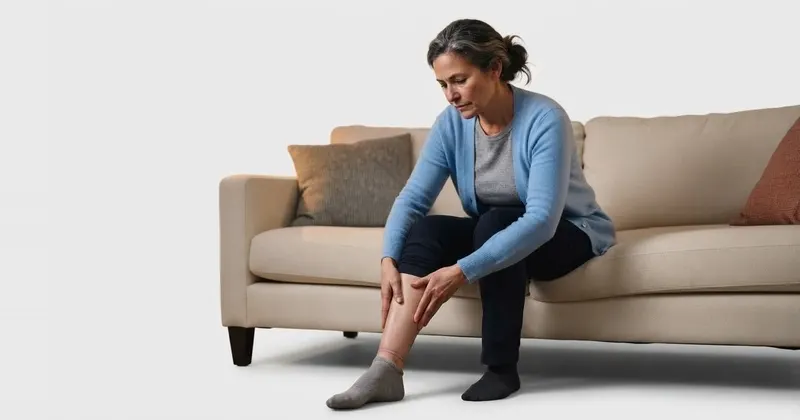
By six o'clock the socks have left a ring around both ankles. You press a thumb into your shin and the dent stays a beat longer than it should. The legs feel full, the way a bag feels full.
저녁 여섯 시쯤이면 양쪽 발목에 양말 자국이 동그랗게 남아 있어요. 정강이를 엄지로 눌러 보면 자국이 생각보다 늦게 올라오고요. 다리가 꽉 찬 느낌. 짐을 가득 넣은 가방처럼요.
"I came in about my legs. Why are you looking at my back?" We hear it often. The answer is one muscle: your diaphragm. In this series we've followed it from the front of your spine to the three openings that pass through it. This one is about the opening at T8, the one your legs depend on.
"다리 때문에 왔는데, 왜 등을 보세요?" 진료실에서 자주 듣는 말이에요. 답은 근육 하나, 횡격막(diaphragm)이에요. 이 시리즈에서는 횡격막이 척추 앞면에 어떻게 매달려 있는지, 그 근육을 무엇이 뚫고 지나가는지 따라왔어요. 오늘은 그중 T8 통로 이야기예요. 다리가 기대고 있는 바로 그 자리요.
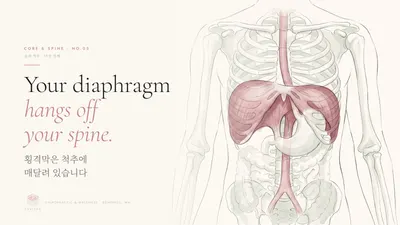
Earlier in the series: Your diaphragm hangs off your spine · 횡격막은 척추에 매달려 있습니다
Your legs have two pumps
다리에는 펌프가 두 개 있어요
Blood in your feet sits nearly your whole height below your heart. Going down is easy. Coming back up, it needs help, because veins have thin walls and little push of their own.
발에 있는 피는 심장보다 거의 키만큼 아래에 있어요. 내려가는 건 쉬워요. 올라올 때가 문제죠. 정맥은 벽이 얇고 스스로 미는 힘이 거의 없거든요.
The first pump is below. Every step, your calf muscles squeeze the deep veins of the lower leg, and one-way valves stop the blood from sliding back. The second pump is above. The large vein carrying that blood home, the inferior vena cava, runs straight through your diaphragm at about the level of T8. Each time you breathe in, the diaphragm drops and the opening the vein passes through widens. Pressure in the belly rises, pressure in the chest falls, and blood in the vein is drawn up into the chest toward the heart. As you breathe out, the legs empty into the space that was just cleared.
첫 번째 펌프는 아래에 있어요. 걸을 때마다 종아리 근육이 깊은 정맥을 짜 주고, 정맥 안의 판막이 피가 다시 내려가지 않게 막아요. 두 번째 펌프는 위에 있어요. 그 피를 심장으로 데려가는 큰 정맥(inferior vena cava)은 횡격막을 그대로 뚫고 지나가요. 높이로는 T8 언저리예요. 숨을 들이쉬면 횡격막이 내려가면서 정맥이 지나는 구멍이 넓어지고, 배 속 압력은 올라가고 가슴 속 압력은 내려가요. 그 차이로 정맥의 피가 가슴 쪽, 심장 쪽으로 끌려 올라가요. 숨을 내쉴 때는 다리의 피가 그렇게 비워진 자리로 올라오고요.
The calves push from below. The diaphragm draws from above. When both are working, the legs empty. Evening heaviness usually means at least one of them has been idling all day.
종아리는 아래에서 밀고, 횡격막은 위에서 당겨요. 둘 다 제대로 돌면 다리가 비워져요. 저녁의 무거움은 대개 둘 중 하나가 하루 종일 쉬고 있었다는 뜻이에요.
The upper pump hangs off your spine
위쪽 펌프는 척추에 매달려 있어요
The diaphragm isn't a shelf floating inside you. It wraps the inside of the lower ribs, and two long tendons anchor it to the front of the spine where the mid-back meets the low back. The ribs it pulls on hinge on the mid-back, segment by segment, swinging up and out with each breath like a bucket handle.
횡격막은 몸속에 떠 있는 선반이 아니에요. 아래 갈비뼈 안쪽을 감싸고, 긴 힘줄 두 가닥으로 등과 허리가 만나는 자리의 척추 앞면에 단단히 붙어 있어요. 횡격막이 당기는 갈비뼈는 등 한가운데 척추 마디마디에 걸려 있고요. 숨 쉴 때마다 양동이 손잡이처럼 위로, 바깥으로 들려요.
So the upper pump is only as good as the frame it hangs from. Years of sitting forward stiffen a few segments of the mid-back. The ribs attached there stop swinging. Breathing climbs into the neck and upper chest, short and shallow, and the diaphragm barely travels. The upper pump idles, and by evening the legs carry the cost.
그래서 위쪽 펌프는 매달린 틀만큼만 일해요. 몇 년을 앞으로 숙여 앉아 지내면 등 한가운데 몇 마디가 굳어요. 거기 붙은 갈비뼈가 움직이질 않죠. 숨은 목과 윗가슴으로 올라가 짧고 얕아지고, 횡격막은 거의 내려가지 않아요. 위쪽 펌프가 쉬는 거예요. 그 값은 저녁에 다리가 치르고요.
A shallow breath is a weak core, all the way down to the ankle
숨이 얕으면 코어가 약해지고, 그 값은 발목까지 내려가요
There is a second cost, and it lands in the legs too. Your trunk is a closed container: the diaphragm is its lid, the pelvic floor its base, the abdominal wall its front, the spine its back. When the diaphragm comes down, pressure inside the container rises. That pressure is your core. It braces the spine from the front, and it presses down on the pelvis so it stays firm while the legs push against the ground.
두 번째 값도 다리로 내려와요. 몸통 안은 닫힌 통이에요. 뚜껑이 diaphragm, 바닥이 pelvic floor, 앞이 abdominal wall, 뒤가 척추예요. 횡격막이 내려오면 통 안의 압력이 올라가요. 그 압력이 바로 코어예요. 앞에서 척추를 받쳐 주고, 위에서 골반을 지그시 눌러 줘서, 다리가 땅을 밀 때 골반이 흔들리지 않게 잡아 줘요.
A diaphragm that barely travels never fills the container. It's the opened can from our gravity series: the same metal, folding under two fingers, because the pressure has gone. Without it the pelvis has no firm base, and the hips, knees and ankles below it lose theirs. The hip stops driving and the knee stops straightening fully. Each step pushes off a little less. The calf, which only pumps when the ankle works through its range, shortens its stroke. So the lower pump idles as well.
횡격막이 거의 안 내려가면 통이 채워지지 않아요. 중력 시리즈에서 말씀드린 딴 캔이에요. 같은 알루미늄인데 압력이 빠지니 손가락 두 개에 찌그러지죠. 압력이 없으면 골반이 단단히 서 있을 바닥을 잃고, 그 아래 고관절, 무릎, 발목도 같이 기댈 데를 잃어요. 고관절은 밀지 못하고 무릎은 끝까지 펴지지 않아요. 걸음마다 땅을 차는 힘도 조금씩 줄고요. 종아리는 발목이 끝까지 움직여야 펌프질을 하는데, 그 폭이 짧아지는 거예요. 아래 펌프도 그렇게 쉬게 돼요.
One stiff stretch of mid-back, and both pumps idle. That is why heavy legs bring us to your spine.
등 한가운데 몇 마디가 굳었을 뿐인데, 펌프 두 개가 다 쉬어요. 다리가 무거운데 저희가 척추를 보는 이유예요.
Read with: The Spine Under Gravity, Part Two: Pressure, and What to Do · 중력 아래의 척추 2부, 압력 그리고 할 일
This is where chiropractic care does its work
카이로프랙틱이 일하는 자리가 바로 여기예요
In chiropractic terms, those stiff levels are segments that have stopped doing their share, and the neighbors above and below are working overtime to cover for them. We find them by hand, one segment at a time, and adjust them so the ribs get their hinge back. Then we work the soft tissue along the lower ribs and the diaphragm itself so the muscle can travel its full distance again.
카이로프랙틱으로 보면, 굳은 마디는 제 몫을 못 하고 있는 마디예요. 그만큼을 위아래 마디가 떠맡느라 과로하고 있고요. 저희는 그 마디를 손으로 한 마디씩 찾아서 교정해요. 갈비뼈에 경첩을 돌려주는 거예요. 그다음 아래 갈비뼈를 따라 붙은 연부조직과 횡격막 자체를 풀어서, 근육이 끝까지 내려갈 수 있게 해요.
Hands-on research backs this up. In randomized trials with healthy adults, manual work around the diaphragm and lower ribs let the rib cage open measurably wider than a sham treatment, and on ultrasound the diaphragm itself travelled further with each breath. After a mid-back adjustment, breathing-test numbers in desk-bound young adults went up. A frame that moves lets the diaphragm work the way it was built to. Then we teach you to keep it moving at home, because the more often you breathe low, the more often the upper pump runs.
손으로 하는 치료 연구도 이걸 뒷받침해요. 건강한 성인을 대상으로 한 무작위 연구에서, 횡격막과 아래 갈비뼈 주변을 손으로 풀어 준 쪽이 가짜 치료를 받은 쪽보다 갈비뼈가 눈에 띄게 더 벌어졌어요. 초음파로 보니 횡격막도 숨 쉴 때마다 더 깊이 내려갔고요. 오래 앉아 지내는 젊은 성인들은 등 한가운데를 교정받은 뒤 호흡 검사 수치가 올라갔어요. 틀이 움직이면 횡격막은 원래 만들어진 대로 일해요. 그다음 집에서도 그 움직임을 지키는 법을 알려 드려요. 아래로 숨 쉬는 횟수가 늘수록 위쪽 펌프가 도는 횟수도 늘거든요.
What a visit at Levitas looks like
Levitas에서는 이렇게 봐요
We take our time. We watch you breathe sitting and lying down, and see whether the lower ribs widen or only the chest rises. We check whether you can build pressure in the trunk, every segment of the mid-back and low back by hand, and how your hips, knees and ankles take your weight, because the lower pump matters as much as the upper one. We ask about your day: how long you sit, and what time the heaviness starts.
저희는 서두르지 않아요. 앉아서, 누워서 숨 쉬는 모습을 보고, 아래 갈비뼈가 벌어지는지 가슴만 들리는지 확인해요. 몸통 안에 압력을 만들 수 있는지, 등 한가운데와 허리를 손으로 한 마디씩 짚어 보고, 고관절, 무릎, 발목이 체중을 어떻게 받는지도 봐요. 아래 펌프도 위 펌프만큼 중요하니까요. 하루를 어떻게 보내시는지도 여쭤봐요. 얼마나 오래 앉아 계시는지, 몇 시쯤부터 무거워지는지요.
Then the work runs in order. If something hurts, we get that down first, because nothing else holds while it's loud. Then we restore motion: the stiff segments and their ribs first, then the diaphragm. Then we teach the pattern, a breath that fills the container and a core that holds it, and then we load it through the hips, knees and ankles so the change belongs to you. Last comes keeping what was rebuilt.
그다음은 순서대로 가요. 아픈 데가 있으면 그것부터 내려요. 통증이 큰 동안에는 뭘 해도 붙지 않거든요. 그다음 움직임을 돌려줘요. 굳은 마디와 거기 붙은 갈비뼈를 먼저, 그다음 횡격막을요. 그리고 패턴을 가르쳐요. 통을 채우는 숨, 그 압력을 붙잡는 코어요. 그다음 고관절, 무릎, 발목으로 부하를 실어요. 그래야 변화가 환자분 것이 돼요. 마지막은 그렇게 되찾은 걸 지키는 일이에요.
Who comes in for this
이런 분들이 오세요
Nurses coming off a twelve-hour shift. Teachers who stand all day and barely walk. Remote workers who can go from breakfast to dinner without leaving the home office, and commuters who add an hour on I-5 to the end of it. People who step off a cross-country flight with shoes that suddenly feel a size too small. And anyone who has been told to put their feet up and drink more water, did both, and still drags their legs up the stairs at night.
12시간 근무를 마친 간호사. 하루 종일 서 있지만 정작 걷지는 않는 선생님. 아침부터 저녁까지 홈오피스를 한 번도 안 나서는 재택근무자, 거기에 I-5에서 한 시간을 더 보내는 출퇴근길. 미국 횡단 비행기에서 내렸더니 신발이 한 치수 작아진 것 같은 분. 그리고 다리 올리고 물 많이 마시라는 말을 듣고 둘 다 해 봤는데, 밤이면 여전히 다리를 끌고 계단을 오르시는 분이요.
What we'll have you do tonight
오늘 저녁 해 보실 것
Legs up, breath low. Lie down with your calves on a cushion or the sofa arm. One hand on your chest, one on your belly. Breathe in through your nose and let the lower hand rise first while the lower ribs widen to the sides. Breathe out slowly, a little longer than the in-breath. A few minutes is enough.
다리는 올리고, 숨은 아래로. 누워서 종아리를 쿠션이나 소파 팔걸이에 올려 두세요. 한 손은 가슴에, 한 손은 배에 얹고요. 코로 들이쉬면서 아래쪽 손이 먼저 올라오고 아래 갈비뼈가 옆으로 벌어지게 해요. 내쉴 때는 들이쉰 것보다 조금 더 길게요. 몇 분이면 충분해요.
Fill the container. Lie on your back, knees bent and together. Breathe in through the nose and let the belly rise. Then bring the ribs down and the pubic bone up toward them, and push your soles away along the floor. Let the low back meet the floor, and breathe out slowly while you hold it. Five seconds at first.
통을 채우기. 무릎을 세워 붙이고 바로 누워요. 코로 들이쉬어 배를 부풀리고, 갈비뼈는 내리고 치골은 갈비뼈 쪽으로 가져오면서 발바닥으로 바닥을 멀리 밀어요. 허리가 바닥에 닿으면 천천히 내쉬면서 그대로 버텨요. 처음엔 5초면 돼요.
Get up once an hour. A walk to the kitchen counts. The lower pump only runs when the ankle moves.
한 시간에 한 번은 일어나세요. 부엌까지 걸어갔다 오는 것도 충분해요. 아래 펌프는 발목이 움직일 때만 돌아가요.
Ankle pumps at the desk. Feet flat, lift the toes, then the heels. Slowly, ten to twenty times.
책상 밑 발목 펌프. 발바닥을 바닥에 두고 발끝을 들었다가, 뒤꿈치를 들어요. 천천히 열 번에서 스무 번.
If the lower hand won't rise no matter what you try, that's the frame talking. That's the part we look at.
아무리 해도 아래쪽 손이 안 올라온다면, 틀이 굳어 있다는 신호예요. 바로 그 부분을 저희가 봐요.
Before anything else, we check
무엇보다 먼저, 확인부터 해요
Your first visit starts with questions and a hands-on check before any treatment. Is it both legs or one? Is a calf tender, warm or red? How long has the swelling been building, and does it go down overnight? What medicines do you take? The common kind is both legs, worse after a long day, better overnight and with movement. Heaviness that doesn't fit that pattern needs a different plan, and we'll tell you so plainly.
첫 방문은 치료보다 확인부터 해요. 한쪽 다리인지 양쪽인지, 종아리를 눌렀을 때 아프거나 뜨겁거나 붉지 않은지, 붓기가 언제부터 생겼고 자고 나면 빠지는지, 드시는 약이 있는지요. 흔한 무거움은 양쪽 다리가, 오래 앉거나 서 있은 날 더 심하고, 자고 나거나 움직이면 나아져요. 그 모양과 다르면 계획도 달라져야 해요. 그럴 땐 분명하게 말씀드려요.
A note before you go
마지막으로
Heavy legs rarely get anyone's full attention. They're not dramatic enough. They just make the last hours of the day smaller, one evening at a time. You don't have to keep living around them. Come in and let us look at both pumps, from your ankles to the segment your diaphragm hangs from. Wear something loose at the waist, and the shoes you work in.
다리 무거움은 대개 누구의 관심도 제대로 받지 못해요. 크게 아픈 게 아니니까요. 그저 저녁마다 하루의 마지막 몇 시간을 조금씩 작게 만들 뿐이죠. 그렇게 맞춰 사실 필요는 없어요. 한번 들러 주세요. 발목부터 횡격막이 매달린 척추 마디까지, 두 펌프를 함께 볼게요. 허리가 편한 옷에, 일할 때 신는 신발 그대로 오시면 좋아요.
Thanks for reading. Questions are welcome by phone or email. We answer every one.
읽어 주셔서 고마워요. 궁금한 건 전화나 이메일로 편하게 물어보세요. 하나하나 답해 드려요.
Next in the series: T10 · The valve that also breathes · 숨을 쉬는 밸브
View the full brochure · 브로셔 전체 보기