Quick answer · 짧은 답
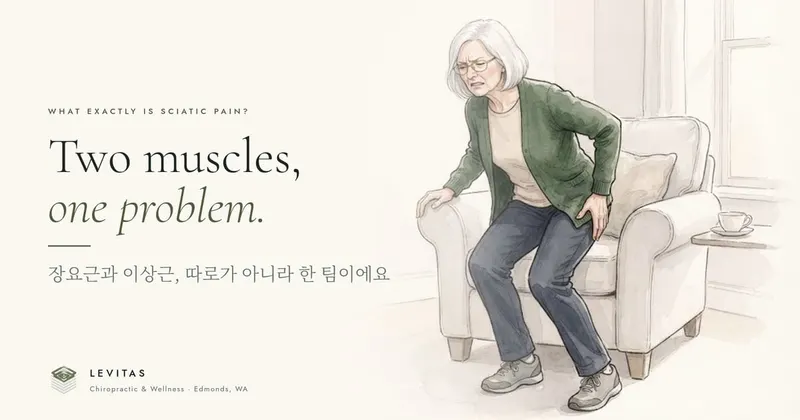
The psoas and the piriformis attach to the same two places, the base of the spine and the top of the thigh bone. When long sitting shortens the psoas, the low back arches and narrows the openings where the nerve roots exit. When the thigh stays rotated outward, the piriformis overworks and tightens right over the sciatic nerve. One nerve, two pressure points.
장요근과 이상근은 척추 아래와 허벅지뼈 위쪽, 같은 두 곳에 붙어 있어요. 오래 앉아 장요근이 짧아지면 허리가 젖혀지면서 신경 뿌리가 나오는 통로가 좁아지고, 허벅지가 바깥으로 돌아간 채 굳으면 이상근이 과하게 일하면서 좌골신경 바로 위에서 뻣뻣해져요. 신경 하나가 두 군데에서 눌리는 거예요.
"It's not really my back. It's my leg." We hear some version of that almost every week. The pain runs down the back of the thigh, sometimes past the knee, and it's usually at its worst after a long drive, a long dinner, or any chair you ended up sitting in longer than you planned.
"허리는 그렇게 안 아픈데요, 다리가 아파요." 진료실에서 거의 매주 듣는 말이에요. 허벅지 뒤쪽이 타는 것처럼 아프고, 심한 날은 무릎 아래까지 내려가요. 특히 운전을 오래 하고 내렸을 때, 식사 자리가 길어졌을 때, 생각보다 오래 앉아 있다가 일어날 때 더 심해지죠.
Chances are you've already heard two names: the psoas and the piriformis. Maybe someone even showed you a stretch for each. Most people do those stretches for a week or two and then move on. What usually doesn't get explained is that these two muscles aren't separate problems. They're working together, from the front and the back, on the same problem.
아마 장요근(psoas)과 이상근(piriformis)이라는 이름은 이미 들어보셨을 거예요. 스트레칭을 하나씩 배우셨을 수도 있고요. 그런데 대부분 한두 주 따라 하다가 그만두세요. 정작 이 두 근육이 따로따로의 문제가 아니라는 설명은 잘 못 들으셨을 거예요. 앞과 뒤에서 같은 문제를 함께 붙잡고 있는 근육들이거든요.
First, what sciatica actually is
먼저, 좌골신경통이 정확히 뭘까요
The sciatic nerve is the largest nerve in the body. It's formed by nerve roots that leave the lower spine between L4 and S3. Those roots come together inside the pelvis, exit through the back of the pelvis into the buttock, and pass right underneath the piriformis on the way down the leg.
좌골신경(sciatic nerve)은 우리 몸에서 가장 굵은 신경이에요. 허리 아래쪽 L4부터 S3 사이에서 나온 신경 뿌리들이 골반 안에서 하나로 모여 만들어지는데요. 골반 뒤쪽으로 나와 엉덩이를 지나고, 이상근 바로 밑을 통과해서 다리로 내려가요.
"Sciatica" simply means pain that follows that path. It tells us where it hurts, not why. Most of the time, the irritation starts at the spine, where a disc or a narrowed opening crowds one of the nerve roots. But for some people, the pressure comes from lower down, deep in the buttock, where the muscle and the nerve share a very tight space.
좌골신경통은 이 신경이 지나가는 길을 따라 아픈 걸 말해요. 어디가 아픈지는 알려주지만, 왜 아픈지까지 알려주진 않아요. 대부분은 척추에서 시작되는데요, 디스크나 좁아진 통로가 신경 뿌리를 누르는 경우예요. 그런데 그보다 아래, 엉덩이 깊은 곳에서 눌리는 분들도 있어요. 근육과 신경이 아주 좁은 공간을 같이 쓰는 자리거든요.
Here's the part that rarely comes up: for many people, it isn't one or the other. It's both at the same time, along the same nerve.
그리고 잘 안 알려진 사실이 하나 있어요. 많은 분들이 둘 중 하나가 아니라 둘 다예요. 같은 신경이 두 군데에서 동시에 눌리고 있는 거죠.
Meet the two muscles
두 근육을 먼저 알아볼게요
The psoas sits in the front. It starts along the sides of the lower spine, from T12 down through the lumbar vertebrae, travels through the pelvis, and attaches to a small bump on the inner thigh bone called the lesser trochanter. Its job is to lift your knee toward your chest. It's also the only muscle that connects the spine directly to the leg.
장요근은 앞쪽에 있어요. 허리뼈 옆면, T12부터 허리뼈 전체에 걸쳐 시작해서 골반 안을 지나 허벅지뼈 안쪽의 작은 돌기(lesser trochanter)에 붙어요. 무릎을 가슴 쪽으로 들어 올리는 근육이에요. 척추와 다리를 직접 이어주는 유일한 근육이기도 하고요.
The piriformis sits in the back. It starts on the front surface of the sacrum, the flat bone at the base of the spine, crosses the buttock, and attaches to the top of the bony point on the outside of your hip, called the greater trochanter. When your leg is straight, it rotates the thigh outward. It also helps keep your pelvis level whenever you stand on one leg, which happens with every single step.
이상근은 뒤쪽에 있어요. 척추 맨 아래에 있는 납작한 뼈, 천골(sacrum)의 앞면에서 시작해서 엉덩이를 가로질러, 고관절 바깥쪽 큰 돌기(greater trochanter) 위에 붙어요. 다리를 편 상태에서는 허벅지를 바깥으로 돌려주고요. 한 발로 설 때 골반이 기울지 않게 잡아주는 역할도 해요. 걸을 때마다 매 걸음이 한 발로 서는 순간이니까, 생각보다 일을 많이 하는 근육이에요.
What about the "5% trap"?
혹시 "5%의 함정"이라는 이야기를 보셨나요
You may have seen an illustration of the sciatic nerve running right through the piriformis, along with the claim that some people are simply "built" for sciatica. That variation does exist. One large review that combined data from more than six thousand cadavers found some kind of unusual nerve-and-muscle arrangement in about one out of six people.
좌골신경이 이상근 한가운데를 뚫고 지나가는 그림과 함께, 어떤 사람은 타고나기를 좌골신경통에 잘 걸리는 구조라는 글을 보셨을 수도 있어요. 그런 구조가 실제로 있긴 해요. 시신 육천 구 이상을 모아 분석한 연구를 보면, 여섯 명 중 한 명 정도는 신경과 근육의 위치가 일반적인 경우와 달랐어요.
But that same review found something even more helpful. People who needed surgery for piriformis-related nerve pain had that variation at almost exactly the same rate as everyone else. In other words, the anatomy you were born with matters less than it sounds. What matters more is what that muscle is being asked to do all day.
그런데 같은 연구에서 더 중요한 결과가 나왔어요. 이상근 때문에 신경 통증으로 수술까지 받은 분들도, 그런 구조를 가진 비율이 일반인과 거의 똑같았던 거예요. 타고난 구조가 생각만큼 결정적이지는 않다는 뜻이에요. 그보다는 그 근육이 하루 종일 어떤 일을 떠맡고 있느냐가 훨씬 중요해요.
That's actually good news. You can't change your anatomy, but you can change the load.
사실 반가운 이야기예요. 타고난 구조는 바꿀 수 없지만, 근육에 걸리는 부담은 얼마든지 바꿀 수 있으니까요.
Why they're really one problem
두 근육이 왜 결국 하나의 문제인지
Take a look at where they attach. At the top, both are anchored to the base of the spine and the pelvis. At the bottom, both grab the thigh bone near the hip. And when the hip is straight, both can rotate the thigh outward. One pulls from the front and one from the back, but they're pulling on the same two spots.
두 근육이 붙는 자리를 보시면 이해가 쉬워요. 위쪽은 둘 다 척추 아래와 골반에 붙어 있고, 아래쪽은 둘 다 고관절 근처 허벅지뼈를 잡고 있어요. 고관절을 편 상태에서는 둘 다 허벅지를 바깥으로 돌릴 수 있고요. 하나는 앞에서, 하나는 뒤에서 당기지만 결국 같은 두 곳을 당기고 있는 거예요.
Now add a chair. Sitting for hours keeps the hip bent, and when a muscle spends enough time in a shortened position, it tends to stay that way. So when you stand up, a tight psoas won't let the hip fully straighten. Something else has to make up the difference, and that's usually the low back. The lower spine arches more, and the pelvis tips forward so you can stand upright.
여기에 의자를 생각해 볼게요. 몇 시간씩 앉아 있으면 고관절이 계속 접혀 있어요. 근육은 짧은 상태로 오래 있으면 그 길이에 익숙해지거든요. 그래서 일어설 때 짧아진 장요근이 고관절을 끝까지 펴주지 못해요. 그럼 다른 곳이 대신 펴져야 하는데, 대부분 허리가 그 역할을 해요. 허리가 평소보다 더 젖혀지고, 골반이 앞으로 기울어야 겨우 똑바로 설 수 있는 거죠.
That extra arch matters for the nerve. When the lower spine bends backward, the openings where the nerve roots exit get smaller. In cadaver studies, extending the spine made those openings about 15% smaller than in a neutral position, and nerve roots were compressed noticeably more often. That's the first pressure point, at the spine.
이렇게 허리가 젖혀지는 게 신경에는 꽤 중요해요. 허리가 뒤로 젖혀지면 신경 뿌리가 빠져나오는 통로(intervertebral foramen)가 좁아지거든요. 시신 연구에서 허리를 젖혔을 때 이 통로가 바른 자세보다 15% 정도 좁아졌고, 신경 뿌리가 눌리는 경우도 눈에 띄게 많아졌어요. 이게 첫 번째로 눌리는 자리, 척추예요.
Meanwhile, the thigh has been rotated outward and is staying there. Next time you stand up after a long sit, look down at your feet. If they're pointing outward like a duck's, that's your hip showing you which way it's stuck. In that position, the big glute muscles tend to switch off, and the much smaller piriformis takes over their job of stabilizing the pelvis. It isn't built to handle that all day. Over time it tightens and thickens, and the nerve running right underneath it has less room. That's the second pressure point.
그러는 동안 허벅지는 바깥으로 돌아간 채로 굳어 있어요. 오래 앉아 있다가 일어나실 때 발끝을 한번 내려다보세요. 오리발처럼 바깥을 향하고 있다면, 고관절이 그 방향으로 굳어 있다는 신호예요. 이 자세에서는 엉덩이의 큰 근육(gluteus maximus, gluteus medius)이 제 역할을 잘 못 하고, 훨씬 작은 이상근이 골반을 잡아주는 일을 대신 떠맡게 돼요. 하루 종일 그 일을 하라고 만들어진 근육이 아니거든요. 그러다 보니 점점 뻣뻣해지고 두꺼워지고, 바로 밑을 지나는 신경은 공간이 좁아져요. 이게 두 번째로 눌리는 자리예요.
One nerve, two pressure points. A nerve that's already irritated at the spine can tolerate much less pressure in the buttock, and the reverse is true too. That's why stretching just one of these muscles often stops helping after a week or so.
신경은 하나인데 눌리는 곳은 두 군데인 거죠. 척추에서 이미 예민해진 신경은 엉덩이에서 오는 압박을 훨씬 못 견디고, 반대도 마찬가지예요. 한쪽 근육만 스트레칭하면 일주일쯤 지나서 효과가 멈추는 이유가 바로 이거예요.
It doesn't stop at the hip
고관절에서 끝나지 않아요
When the thigh stays rotated outward, it changes how the knee lines up over the foot. The foot turns out, the arch tends to flatten, and the inside of the knee ends up carrying load it wasn't designed to carry. We see people come in for knee pain, and the conversation ends up at the hip.
허벅지가 바깥으로 돌아간 채로 있으면 무릎과 발이 놓이는 방향도 같이 틀어져요. 발끝이 벌어지고, 발 아치가 내려앉기 쉽고, 무릎 안쪽에 원래보다 많은 부담이 실리게 돼요. 그래서 무릎이 아파서 오셨다가 결국 고관절 이야기를 하게 되는 분들이 꽤 많아요.
The same thing happens going up the spine. When the low back holds a deeper arch, the body has to balance that curve somewhere higher up. Often the upper back rounds and the head drifts forward, and the neck ends up compensating for a hip that never fully straightened.
위쪽으로도 마찬가지예요. 허리가 더 젖혀져 있으면 몸은 그 위 어딘가에서 균형을 맞추려고 해요. 그래서 등이 굽고 머리가 앞으로 빠지는 경우가 많고, 결국 끝까지 펴지지 못한 고관절 때문에 목까지 고생하게 되는 거죠.
That's why we look at how you stand and walk, not just where it hurts.
그래서 저희는 아픈 곳만 보지 않고, 서 계신 자세와 걸으시는 모습까지 같이 봐요.
Why it's different as we get older
나이가 들면 왜 더 복잡해질까요
For older adults, there are two more things to consider.
나이가 드신 분들은 여기에 두 가지가 더 겹쳐요.
The first is space. As we age, discs lose height, ligaments thicken, and the small joints of the spine develop bony edges. So the openings for the nerve roots are often already narrower, even before the low back starts to arch. There just isn't much room to spare.
첫 번째는 공간이에요. 나이가 들면 디스크 높이가 낮아지고, 인대가 두꺼워지고, 척추 관절 가장자리에 뼈가 자라요. 그래서 허리가 젖혀지기 전부터 이미 신경이 지나는 통로가 좁아져 있는 경우가 많아요. 처음부터 여유가 별로 없는 상태인 거죠.
The second is muscle. Muscle mass and strength decline steadily with age, and that includes the deep muscles around the spine and hips. Research in older adults has linked more fat within the trunk muscles to more back pain and more difficulty with everyday tasks. As the larger muscles weaken, smaller ones like the piriformis get pushed into work they can't keep up with.
두 번째는 근육이에요. 나이가 들수록 근육량과 근력은 꾸준히 줄어드는데, 척추와 고관절을 받쳐주는 깊은 근육도 예외가 아니에요. 노년층 연구를 보면 몸통 근육 안에 지방이 많을수록 허리 통증이 심하고, 일상적인 동작도 더 힘들어하는 경향이 있었어요. 큰 근육이 약해지면 이상근 같은 작은 근육이 감당하기 힘든 일까지 떠맡게 되고요.
This is where a lot of people get stuck. An injection or a round of medication can calm an irritated nerve, and research on spinal injections for sciatica shows real relief, though it usually doesn't last long. A good massage can relax a muscle that's been guarding for weeks. All of these have their place. Bringing the pain down comes first.
많은 분들이 여기서 막히세요. 주사나 약은 예민해진 신경을 가라앉혀 줄 수 있어요. 좌골신경통 주사에 대한 연구를 보면 효과는 분명히 있지만, 대개 오래가지는 않아요. 마사지도 몇 주째 잔뜩 긴장해 있던 근육을 풀어줄 수 있고요. 다 필요한 것들이에요. 통증부터 줄이는 게 먼저니까요.
But none of them build muscle. A thigh that's been rotated outward for years, glutes that have stopped doing their job, a psoas that has lost its full length. None of that changes just because the pain eased up for a while. When the injection wears off, you're getting up out of the same chair, in the same body, the same way. And the pain tends to come back, often a bit stronger, because the muscle kept weakening in the meantime.
하지만 어느 것도 근육을 만들어 주지는 않아요. 몇 년째 바깥으로 돌아가 있던 허벅지, 제 역할을 놓아버린 엉덩이 근육, 원래 길이를 잃어버린 장요근은 통증이 잠깐 줄었다고 해서 달라지지 않거든요. 주사 효과가 떨어지면 같은 몸으로, 같은 의자에서, 같은 방식으로 일어나시게 돼요. 그사이 근육은 계속 약해졌으니, 통증은 대개 조금 더 심해져서 돌아와요.
The encouraging part is that older muscles still respond. In one well-known study, people in their nineties became noticeably stronger with supervised strength training. The body doesn't lose its ability to rebuild. It just needs the challenge to come in stages, a little more each time, starting from wherever that person is today.
그래도 희망적인 건, 나이 든 근육도 여전히 반응한다는 거예요. 잘 알려진 연구에서 90대 어르신들이 지도를 받으며 근력 운동을 했더니 근력이 눈에 띄게 좋아졌어요. 몸이 다시 회복하는 능력은 나이가 들어도 사라지지 않아요. 다만 지금 그분이 할 수 있는 데서 시작해서, 조금씩 단계를 올려가야 해요.
That's why, especially for older patients, this can't be a one-and-done approach. It needs a plan. It starts with calming the nerve, then moves to waking up the glutes in positions that feel safe, then to standing and walking exercises, and it continues long enough for the muscle to truly come back. Skipping steps is how people get hurt. Stopping too early is how the pain returns.
그래서 특히 어르신들은 한 번으로 끝낼 수 있는 일이 아니에요. 계획이 필요해요. 먼저 예민해진 신경을 가라앉히고, 편안하고 안전한 자세에서 엉덩이 근육을 깨우고, 그다음 서서 하는 운동과 걷는 운동으로 넘어가요. 그리고 근육이 정말로 돌아올 때까지 꾸준히 이어가야 해요. 단계를 건너뛰면 다치기 쉽고, 너무 일찍 멈추면 통증이 다시 찾아오거든요.
A few things you can check at home
집에서 한번 확인해 보세요
Lie on your back and let your legs relax. If one foot falls outward much more than the other, that hip may be stuck in outward rotation.
바로 누워서 다리 힘을 빼 보세요. 한쪽 발이 다른 쪽보다 훨씬 바깥으로 넘어간다면, 그쪽 고관절이 바깥으로 돌아간 채 굳어 있을 수 있어요.
Empty your back pocket. Sitting on a wallet tilts the pelvis and presses right on the area where the nerve passes.
뒷주머니를 비워 주세요. 지갑을 넣고 앉으면 골반이 기울고, 신경이 지나가는 자리를 그대로 누르게 돼요.
If your low back hurts too, stretch the piriformis lying down instead of sitting. The popular seated figure-4 stretch bends the low back forward under load. Lying on a mat and gently pulling your knee toward the opposite shoulder is much easier on the back.
허리도 같이 아프시다면, 이상근 스트레칭은 앉아서 말고 누워서 하세요. 많이 하시는 의자에 앉은 숫자 4 자세는 상체를 숙이면서 허리에 부담이 많이 가요. 매트에 누워서 무릎을 반대쪽 어깨 쪽으로 살살 당겨 주시는 게 허리에 훨씬 편해요.
Go easy with massage balls and foam rollers. Focus on the outer and upper parts of the buttock, and avoid the center where the nerve runs. Pressing hard on an irritated nerve usually makes it more sensitive, not less.
마사지볼이나 폼롤러는 살살 쓰세요. 엉덩이 바깥쪽과 위쪽 위주로 풀어 주시고, 신경이 지나가는 한가운데는 피해 주세요. 예민해진 신경을 세게 누르면 오히려 더 예민해지는 경우가 많아요.
When not to wait
이럴 땐 미루지 마세요
Some symptoms need to be checked the same day: trouble controlling your bladder or bowels, numbness in the groin or inner thighs, or a foot that's getting weaker week by week. These aren't muscle problems, so please don't wait them out.
이런 증상은 그날 바로 확인을 받으셔야 해요. 소변이나 대변 조절이 잘 안 될 때, 사타구니나 허벅지 안쪽에 감각이 없을 때, 발에 힘이 주마다 눈에 띄게 빠질 때요. 근육 문제가 아니니까, 괜찮아지겠지 하고 기다리지 마세요.
How we approach it
저희는 이렇게 접근해요
We start by figuring out which pressure point is the bigger issue, or whether it's both. That means checking the lumbar joints and sacroiliac joints, testing how your hip rotates in and out, and watching how you get up from a chair and walk across the room. As a chiropractic clinic, getting your spine and pelvis moving the way they should is where our work begins.
먼저 어느 쪽이 더 문제인지, 아니면 둘 다인지를 찾아요. 허리 관절과 천장관절(sacroiliac joint)을 확인하고, 고관절이 안쪽과 바깥쪽으로 얼마나 잘 도는지 보고, 의자에서 일어나 걸어가시는 모습도 봐요. 저희는 카이로프랙틱 클리닉이라, 척추와 골반이 제대로 움직이도록 해드리는 것부터 시작해요.
Next, we work on bringing the pain down, because it's hard to make progress while it's flaring. Then comes the part many people never get to: lengthening the psoas without arching the back, helping the glutes take their job back from the piriformis, and building strength in stages that fit your body. For a 75-year-old, the first step might be standing up from a chair without using your hands. That's a real exercise, and it counts.
그다음 통증부터 줄여요. 통증이 심할 때는 다른 걸 해도 진전이 잘 안 되거든요. 그리고 나서 많은 분들이 놓치시는 단계로 넘어가요. 허리를 젖히지 않고 장요근을 늘려 주고, 이상근이 떠맡았던 일을 엉덩이 근육이 다시 하도록 도와드리고, 지금 몸 상태에 맞춰 단계별로 근력을 키워 가요. 일흔다섯 어르신이라면 손 짚지 않고 의자에서 일어나는 것부터 시작할 수도 있어요. 그것도 충분히 의미 있는 운동이에요.
From there, we focus on keeping the strength you've rebuilt. That's what holds up over time.
그렇게 되찾은 근력을 꾸준히 지켜 가는 게 마지막 단계예요. 결국 오래 버텨 주는 건 그 근력이거든요.
If your leg pain has been hanging around for a while, we'd be glad to take a look. Wear something comfortable you can move in, since we'll want to see you walk.
다리 통증이 꽤 오래가고 있다면, 편하게 한번 들러 주세요. 걸으시는 모습을 봐야 해서, 움직이기 편한 옷을 입고 오시면 좋아요.
References
Koes, B. W., van Tulder, M. W., & Peul, W. C. (2007). Diagnosis and treatment of sciatica. BMJ, 334(7607), 1313–1317.
Bogduk, N., Pearcy, M., & Hadfield, G. (1992). Anatomy and biomechanics of psoas major. Clinical Biomechanics, 7(2), 109–119.
Penning, L. (2000). Psoas muscle and lumbar spine stability: a concept uniting existing controversies. European Spine Journal, 9(6), 577–585.
Delp, S. L., Hess, W. E., Hungerford, D. S., & Jones, L. C. (1999). Variation of rotation moment arms with hip flexion. Journal of Biomechanics, 32(5), 493–501.
Smoll, N. R. (2010). Variations of the piriformis and sciatic nerve with clinical consequence: a review. Clinical Anatomy, 23(1), 8–17.
Inufusa, A., An, H. S., Lim, T. H., Hasegawa, T., Haughton, V. M., & Nowicki, B. H. (1996). Anatomic changes of the spinal canal and intervertebral foramen associated with flexion-extension movement. Spine, 21(21), 2412–2420.
Hopayian, K., Song, F., Riera, R., & Sambandan, S. (2010). The clinical features of the piriformis syndrome: a systematic review. European Spine Journal, 19(12), 2095–2109.
Hicks, G. E., Simonsick, E. M., Harris, T. B., et al. (2005). Cross-sectional associations between trunk muscle composition, back pain, and physical function in the Health, Aging and Body Composition Study. Journals of Gerontology Series A, 60(7), 882–887.
Pinto, R. Z., Maher, C. G., Ferreira, M. L., et al. (2012). Epidural corticosteroid injections in the management of sciatica: a systematic review and meta-analysis. Annals of Internal Medicine, 157(12), 865–877.
Fiatarone, M. A., Marks, E. C., Ryan, N. D., et al. (1990). High-intensity strength training in nonagenarians: effects on skeletal muscle. JAMA, 263(22), 3029–3034.
Anatomical plates in the brochure adapted from Gray, H. (1918). Anatomy of the Human Body. Public domain.
View the full brochure · 브로셔 전체 보기