 See it all as a brochure그림으로 한눈에 보는 브로셔 · 눌러서 보기
Quick answer · 짧은 답
Foam rolling works mostly through the nervous system and the fluid between tissue layers, not by reshaping fascia. One session increases range of motion about as much as stretching, without costing strength, and studies have measured the gain out to 10 to 20 minutes, so use it right away. Roll slowly, 30 to 120 seconds per muscle, at a pressure you can breathe through.
폼롤러는 근막 모양을 바꾸기보다 주로 신경과 층 사이 물기에 작용해요. 한 번만 해도 스트레칭만큼 가동범위가 늘고 근력은 떨어지지 않아요. 연구에서 효과를 확인한 건 10~20분까지라서 바로 움직여서 쓰세요. 근육 하나에 30~120초, 숨을 편하게 쉴 수 있는 압력으로 천천히 굴려요.
A foam roller is about the simplest piece of equipment there is. That simplicity hides a fairly interesting piece of physiology. When you lie on one, four things change: how your tissue layers slide, how your nervous system reads the area, how much range you can use, and, for a short while, how your blood vessels behave. None of them involve "breaking up" anything.
폼롤러만큼 단순한 운동 도구도 드물어요. 그런데 그 단순한 원통 위에 누우면 몸 안에서는 꽤 흥미로운 일이 일어나요. 바뀌는 건 네 가지예요. 조직 층이 미끄러지는 정도, 신경이 그 부위를 느끼는 방식, 쓸 수 있는 가동범위, 그리고 잠깐 달라지는 혈관이에요. 어느 것도 뭔가를 "부수는" 일은 아니에요.
In one line · 한 줄로
Rolling is a signal, not a sledgehammer.
폼롤러는 부수는 도구가 아니라, 몸에 신호를 보내는 도구예요.
Under the skin, tissue is built in layers
피부 아래 조직은 여러 겹이에요
Between your skin and your bones are sheets of connective tissue called fascia. Around the thigh, a thick, tough sleeve, the fascia lata, wraps the whole group of muscles. Underneath it, each muscle has its own thinner wrapping, and each bundle inside the muscle has another.
피부와 뼈 사이에는 근막이라는 결합조직이 여러 겹으로 깔려 있어요. 허벅지는 넓적다리근막(fascia lata)이라는 두껍고 질긴 덮개가 근육 전체를 감싸고, 그 안에서 근육 하나하나가, 다시 그 안의 근육 다발이 각자 얇은 막에 싸여 있어요.
Those layers have to slide over each other every time you move. What lets them slide is a thin film rich in hyaluronan, a long sugar molecule that holds water. Stecco and colleagues (2011) found it sitting exactly where gliding happens: between the fascia and the muscle, and between the sublayers of the fascia itself.
움직일 때마다 이 층들은 서로 미끄러져야 해요. 층 사이에 히알루론산(hyaluronan) 이 많은 얇은 물기 막이 있어서 미끄러질 수 있어요. 히알루론산은 물을 붙잡는 긴 당 분자예요. Stecco 연구팀(2011)은 이 물질이 바로 층이 미끄러지는 자리, 즉 근막과 근육 사이, 그리고 근막 속 얇은 층 사이에 모여 있다는 걸 확인했어요.
Hyaluronan solutions behave like honey: thicker when still and cool, thinner when they are moved and warmed. Researchers have proposed that long hours in one position let this film thicken, and that rolling, by shearing and warming it, helps the layers slide again. That part is still a working model, not a measured fact in living people, but it fits what most people feel: stiff at first, easier after a few slow passes.
히알루론산 용액은 꿀과 비슷해요. 가만히 두고 차가우면 뻑뻑해지고, 저어 주고 따뜻해지면 묽어져요. 그래서 연구자들은 오래 한 자세로 있으면 이 막이 뻑뻑해지고, 폼롤러가 옆으로 밀고 데워 주면서 층이 다시 잘 미끄러지게 돕는다고 봐요. 이 부분은 아직 살아 있는 사람에게서 직접 잰 사실이라기보다 설명 모델이에요. 다만 처음엔 뻣뻣하다가 천천히 몇 번 굴리면 편해지는 느낌과 잘 맞아요.
Connective tissue handles water like a sponge
결합조직은 스펀지처럼 물을 머금었다 내보내요
Much of what gives fascia its body is water held by charged molecules in the space between cells. When tissue is loaded, some of that water is pressed out. When the load comes off, it is drawn back in.
근막이 탄탄한 건 세포 사이에서 전하를 띤 분자들이 물을 붙잡고 있는 덕분이 커요. 조직에 힘이 실리면 물이 일부 밀려 나가고, 힘이 빠지면 다시 빨려 들어와요.
Schleip and colleagues (2012) watched this happen in animal fascia in the lab. Water content dropped right after a stretch and climbed back during rest, sometimes above where it started. It was not a foam-rolling study and it was not in living people, but it shows the principle: connective tissue likes cycles of load and release, and holding one position all day gives it very few.
Schleip 연구팀(2012)은 실험실에서 동물 근막으로 이 과정을 직접 봤어요. 늘린 직후엔 수분이 줄고, 쉬는 동안 다시 늘어나서 때로는 처음보다 많아졌어요. 폼롤러 연구도, 사람 몸 안에서 한 연구도 아니지만 원리는 보여 줘요. 결합조직에는 눌렸다 풀리는 움직임이 필요한데, 하루 종일 같은 자세로 있으면 그런 움직임이 거의 없어요.
The cells that maintain this tissue, fibroblasts, also read mechanical load directly. In Langevin's work (2005), stretching connective tissue changed the shape of these cells within minutes to hours. Load is information to them.
이 조직을 관리하는 섬유아세포도 몸에 실리는 힘을 직접 느껴요. Langevin 연구(2005)에서는 결합조직을 늘리자 몇십 분에서 몇 시간 사이에 이 세포들의 모양이 바뀌었어요. 세포는 힘을 신호로 받아들여요.
Why it isn't "breaking up" fascia
근막을 "부수는" 게 아닌 이유
The thigh's fascia lata is remarkably strong. Using a mathematical model with measurements from a volunteer, Chaudhry and colleagues (2008) estimated that compressing the fascia lata by just 1% would take about 9,000 newtons, roughly the weight of 925 kg pressing down. Shearing it sideways by 1% would take about 4,500 newtons. A person lying on a roller produces a small fraction of that.
허벅지의 넓적다리근막은 아주 질겨요. Chaudhry 연구팀(2008)은 자원자 한 명의 측정값과 수학 모델로 계산해 봤는데, 넓적다리근막을 고작 1% 눌러 줄이는 데 약 9,000뉴턴, 그러니까 925kg짜리 무게가 누르는 만큼의 힘이 필요했어요. 옆으로 1% 밀어내는 데도 약 4,500뉴턴이 들고요. 폼롤러 위에 누운 사람의 체중은 그 일부에 불과해요.
So the change you feel within a minute is unlikely to be the tissue being reshaped. It is far more likely to be the nervous system, and the fluid between the layers. That is also why pushing harder does not work better.
그러니 1분 만에 느끼는 변화는 조직 모양이 바뀌어서라고 보기 어려워요. 신경, 그리고 층 사이 물기 쪽일 가능성이 훨씬 커요. 세게 누른다고 더 잘 되는 게 아닌 이유도 여기 있어요.
Fascia is a sensory tissue
근막은 감각을 느끼는 조직이에요
Fascia is threaded with nerve endings. In the low-back fascia, Tesarz and colleagues (2011) found dense free nerve endings, many of them the kind associated with pain, mainly in the outer layers. Their counts were in rats, with early human tissue showing the same pattern. Either way, fascia is not inert wrapping. It is talking to your spinal cord all day.
근막에는 신경 끝이 촘촘히 퍼져 있어요. Tesarz 연구팀(2011)은 허리 근막의 바깥층에서 자유신경종말을 아주 많이 찾았고, 그중 상당수는 통증과 관련된 종류였어요. 숫자를 센 건 쥐였고, 사람 조직도 같은 모습을 보였어요. 어느 쪽이든 근막은 그냥 포장지가 아니라, 척수로 쉬지 않고 신호를 보내는 조직이에요.
Slow, firm pressure fires large, fast sensory fibres. In the spinal cord, that fast input can turn down the signal from the thin, slow fibres that carry pain, an idea first described as the gate control theory (Melzack and Wall, 1965). The brain then gets a new reading of the area: pressure, but no threat. Protective tension drops, and the same stretch feels less sharp.
천천히 꾹 누르면 굵고 빠른 감각신경이 한꺼번에 반응해요. 척수에서는 이 빠른 신호가 가늘고 느린 통증 신경의 신호를 줄일 수 있어요. 1965년 Melzack과 Wall이 처음 설명한 관문 조절 이론이에요. 그러면 뇌는 그 부위를 다시 판단해요. "눌리고 있지만 위험하진 않다." 지키려고 잔뜩 들어가 있던 긴장이 빠지고, 같은 각도로 늘려도 덜 날카롭게 느껴져요.
The clearest evidence that the nervous system is doing much of the work comes from the other leg. In a randomized trial of 150 adults with tender calves, Aboodarda and colleagues (2015) found that rolling one calf raised the pressure-pain threshold in that calf by about 24% and in the opposite calf by about 21%. The roller never touched the other leg.
신경이 큰 몫을 한다는 가장 분명한 증거는 반대쪽 다리에서 나와요. 종아리가 뻐근한 성인 150명을 무작위로 나눈 Aboodarda 연구팀(2015)의 실험에서, 한쪽 종아리를 굴리자 그쪽의 압통 문턱이 약 24%, 굴리지 않은 반대쪽 종아리도 약 21% 올라갔어요. 롤러가 닿지도 않은 다리예요.
The benefits, by the numbers
숫자로 보는 이점
More range of motion, right away. A 2020 meta-analysis of 26 trials (Wilke and colleagues) found that a single bout of foam rolling clearly increased range of motion compared with doing nothing, a large effect, and matched static stretching. In one well-known study (MacDonald, 2013), two minutes of rolling the front of the thigh gave about 10° more knee bend at 2 minutes and about 8° at 10 minutes.
바로 늘어나는 가동범위. 26개 실험을 모은 2020년 메타분석(Wilke 연구팀)에서 폼롤러를 한 번만 해도 아무것도 안 했을 때보다 가동범위를 뚜렷하게 늘렸고(큰 효과), 정적 스트레칭과 비슷했어요. 잘 알려진 연구(MacDonald 2013)에서는 허벅지 앞쪽을 2분 굴리자 무릎 굽힘이 2분 뒤 약 10°, 10분 뒤 약 8° 늘었어요.
No cost to strength. Unlike long static stretches before exercise, rolling in that same study did not reduce force or muscle activation. Healey and colleagues (2014) also found no drop in jump height, force or agility after rolling. That makes it a good warm-up tool.
근력은 그대로. 운동 전에 오래 정적 스트레칭을 하는 것과 달리, 같은 연구에서 폼롤러는 근력도 근육 활성도 떨어뜨리지 않았어요. Healey 연구팀(2014)도 굴린 뒤 점프 높이, 힘, 민첩성이 줄지 않았다고 보고했어요. 그래서 운동 전 준비 운동으로 쓰기 좋아요.
Gains that build over weeks. A 2022 meta-analysis of regular rolling (Konrad and colleagues, 11 studies, 290 people) found a moderate improvement in flexibility over time, larger when people kept it up for more than four weeks. The hamstrings and front of the thigh responded best.
몇 주 쌓이면 더. 꾸준히 굴린 연구를 모은 2022년 메타분석(Konrad 연구팀, 11개 연구, 290명)에서는 유연성이 중간 정도로 좋아졌고, 4주 넘게 이어 간 경우 더 컸어요. 가장 잘 반응한 곳이 햄스트링과 허벅지 앞쪽이었어요.
Less soreness after hard training. Across studies, rolling after exercise reduced how sore muscles felt by about 6% (Wiewelhove, 2019). In a small trial after heavy squats (Pearcey, 2015), 20 minutes of rolling right after and over the next two days left the front of the thigh noticeably less tender. Results vary from study to study, so think of it as taking the edge off.
운동 뒤 덜 뻐근하게. 여러 연구를 모아 보면 운동 뒤 굴렸을 때 근육통 느낌이 약 6% 줄었어요(Wiewelhove 2019). 무거운 스쿼트 뒤 바로, 그리고 이틀 동안 20분씩 굴린 작은 실험(Pearcey 2015)에서는 허벅지 앞쪽 압통이 눈에 띄게 덜했어요. 연구마다 차이가 있으니, 뻐근함을 한 겹 덜어 주는 정도로 생각하시면 돼요.
A short-term lift in blood vessel function. In 10 adults, a session of rolling made arteries less stiff 30 minutes later (pulse wave velocity fell from about 1,202 to 1,074 cm/s) and raised nitric oxide in the blood, a molecule that relaxes vessel walls (Okamoto, 2014). In 21 adults, blood flow in the artery of the outer thigh rose about 74% right after rolling and was still about 53% higher 30 minutes later (Hotfiel, 2017). These are small studies of large arteries, but they suggest the effect reaches beyond the muscle.
잠깐 좋아지는 혈관 반응. 성인 10명 연구에서 폼롤러를 한 번 하고 30분 뒤 동맥이 덜 딱딱해졌고(맥파 속도 약 1,202 → 1,074 cm/s), 혈관 벽을 풀어 주는 산화질소가 핏속에서 늘었어요(Okamoto 2014). 성인 21명 연구에서는 허벅지 바깥쪽 동맥의 혈류가 굴린 직후 약 74%, 30분 뒤에도 약 53% 많았어요(Hotfiel 2017). 둘 다 작은 연구이고 큰 동맥을 잰 것이지만, 효과가 근육 밖까지 닿는다는 걸 보여 줘요.
What the research suggests · 연구가 말해 주는 것
Range of motion ↑ about as much as stretching · 가동범위는 스트레칭만큼 늘어요
Strength and power: no loss · 근력·순발력은 줄지 않아요
Soreness: modestly less · 근육통은 조금 덜해요
Effect window: measured out to 10–20 minutes · 효과는 10~20분까지 확인됐어요
Why the window is short, and what to do with it
효과가 짧은 이유, 그리고 그 시간을 쓰는 법
Most of these changes are about how your nervous system is reading the area right now. That reading drifts back. Studies that track range of motion see the gain clearly at 10 minutes, and in some still at 20, but few follow it much longer (MacDonald, 2013; Kelly and Beardsley, 2016).
이 변화는 대부분 신경이 그 부위를 지금 어떻게 느끼느냐에서 와요. 그 느낌은 시간이 지나면 원래대로 돌아가요. 가동범위를 따라가 본 연구들에서도 10분 뒤엔 뚜렷하고 20분까지 남은 연구도 있지만, 그보다 오래 따라간 연구는 드물어요(MacDonald 2013, Kelly·Beardsley 2016).
So the roller is best used as a doorway. Open the range, then walk through it: squat, lunge, hinge, or do the training you were about to do. Using the new range is what teaches the body that the angle is safe, and that is what lasts. It's the same order we use in the clinic: movement first, then pattern, then load. (More on load in The Load Goes Somewhere.)
그래서 폼롤러는 움직이기 바로 전에 쓰는 게 가장 좋아요. 범위가 늘었으면 바로 그 범위로 움직이세요. 스쿼트, 런지, 힙 힌지(엉덩이를 뒤로 빼며 상체 숙이기), 아니면 하려던 운동을 바로요. 새로 늘어난 범위를 실제로 써야 몸이 그 각도를 안전하다고 배우고, 그게 남아요. 진료실에서 쓰는 순서와 같아요. 움직임 먼저, 그다음 패턴, 그다음 부하예요. (부하 이야기는 부하는 사라지지 않는다 글에 있어요.)
How to roll well: the dose
제대로 굴리는 법: 얼마나
A 2020 review that pooled the research into practical numbers (Behm and colleagues) lands here:
연구를 모아 실제로 쓸 숫자로 정리한 2020년 리뷰(Behm 연구팀)는 이렇게 권해요.
Time: 30 to 120 seconds per muscle, 1 to 3 rounds. · 시간: 근육 하나에 30~120초, 1~3번.
Speed: slow, about 2 to 4 seconds per pass. Fast passes give the nervous system choppy input it can't use. · 속도: 천천히, 한 번 지나가는 데 2~4초. 빨리 왕복하면 자극이 짧게 끊겨서 신경이 제대로 받아들이지 못해요.
Pressure: firm but breathable. If you catch yourself holding your breath, ease off; the muscle is already guarding. · 압력: 묵직하지만 숨은 편한 정도. 숨을 참고 있다면 힘을 빼세요. 근육이 벌써 방어하고 있어요.
Then move: use the new range within the next few minutes. · 그리고 움직이기: 몇 분 안에 늘어난 범위로 움직여요.
More pressure doesn't add benefit. Past a certain point the body reads the input as a threat, tension rises, and a bruise the next day means tissue was damaged.
더 세게 누른다고 이점이 더해지지 않아요. 어느 선을 넘으면 몸이 그 자극을 위협으로 받아들이고 긴장이 올라가요. 다음 날 멍이 들었다면 조직이 상한 거예요.
The front of the thigh (quadriceps)
허벅지 앞쪽 (대퇴사두근)
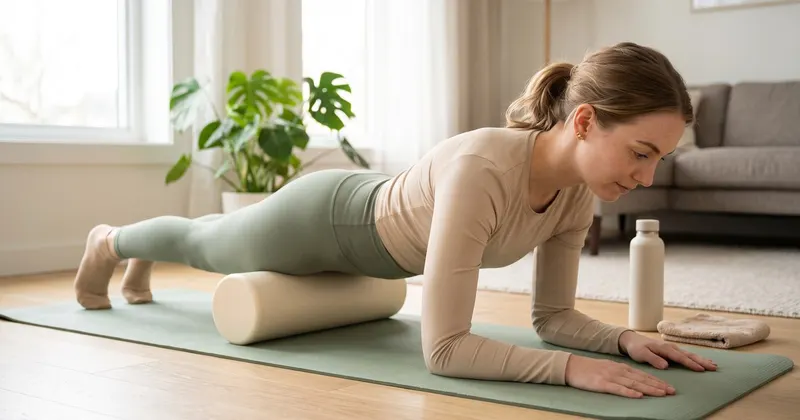
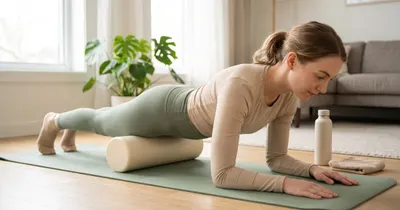
Lie face down with the roller under the front of one thigh, forearms on the floor. Start just above the kneecap and roll slowly up toward the hip, then back. Turn your leg slightly in and out to reach the inner and outer parts of the muscle. When you find a spot where the resistance changes, pause and take three slow breaths. Then stand up and do a few slow lunges or squats.
엎드려서 한쪽 허벅지 앞쪽 아래에 롤러를 두고 팔뚝으로 바닥을 짚어요. 무릎뼈 바로 위에서 시작해 엉덩이 쪽으로 천천히 올라갔다 내려와요. 다리를 살짝 안쪽, 바깥쪽으로 돌려 근육 안쪽과 바깥쪽도 지나가요. 밑에서 느낌이 달라지는 자리가 있으면 멈추고 천천히 세 번 숨을 쉬어요. 그다음 일어나서 천천히 런지나 스쿼트를 몇 번 해요.
The back of the thigh (hamstrings)
허벅지 뒤쪽 (햄스트링)
Sit with the roller under the back of one thigh, hands on the floor behind you. Cross the other leg over the top if you want more pressure. Roll from just above the back of the knee up to just below the sit bone, slowly, turning the leg a little in and out. Then stand and do a few slow hip hinges, reaching your hips back with a long spine. In the 2022 meta-analysis, the hamstrings were one of the places regular rolling made the most difference.
롤러를 한쪽 허벅지 뒤쪽 아래에 두고 앉아서, 손은 몸 뒤 바닥을 짚어요. 압력을 더 주고 싶으면 다른 다리를 위에 겹쳐 올려요. 무릎 뒤 조금 위에서 엉덩이 아래 앉는 뼈 바로 밑까지, 다리를 살짝 안팎으로 돌리면서 천천히 굴려요. 그다음 일어나서 허리를 길게 편 채 엉덩이를 뒤로 빼는 동작(힙 힌지)을 천천히 몇 번 해요. 2022년 메타분석에서 꾸준한 폼롤러가 가장 차이를 낸 곳 중 하나가 햄스트링이었어요.
Where not to roll
굴리지 않는 자리
The low back. There are no ribs to spread the load, so the joints take it. Roll the glutes or upper back instead. · 허리 아래쪽. 하중을 나눠 받을 갈비뼈가 없어서 관절이 다 받아요. 엉덩이나 등 위쪽을 굴리세요.
Directly over bone or the side of the knee. · 뼈 바로 위, 무릎 옆.
Anywhere that tingles, burns or shoots. That's a nerve; move off it. · 저리거나 화끈하거나 찌릿한 자리. 신경이에요. 바로 비켜요.
A fresh injury, swelling or heat. Not that day. · 막 다친 곳, 붓거나 열나는 곳. 그날은 하지 않아요.
How we see it at Levitas
Levitas에서는 이렇게 봐요
A roller works on the tissue it can reach and on how your nervous system reads that area. What it can't reach is a joint that has stopped moving through its range, or the way load travels through your hips, knees and spine. When the same tight spot keeps coming back, that is usually where the answer is.
폼롤러는 롤러가 닿는 조직과, 그 부위를 신경이 느끼는 방식에 작용해요. 하지만 제 범위만큼 움직이지 못하는 관절이나, 고관절·무릎·척추로 힘이 어떻게 실리는지는 바꾸지 못해요. 같은 자리가 계속 뭉친다면 원인은 대개 그쪽에 있어요.
At Levitas we watch you move, test each joint by hand to find the one that has stopped travelling, and restore its motion with a precise adjustment. Then we choose the rolling and exercises that keep that new range, so the work you do at home goes where it should. The roller and the adjustment aren't alternatives. They go in an order.
Levitas에서는 먼저 움직이시는 모습을 보고, 관절을 하나씩 손으로 확인해 멈춰 있는 곳을 찾고, 정확한 교정으로 움직임을 되찾아요. 그다음 그 범위를 지켜 줄 폼롤러와 운동을 골라 드려요. 그래야 집에서 하시는 운동이 효과를 내요. 폼롤러와 교정은 하나를 고르는 게 아니라, 순서대로 가는 거예요.
Who comes in
이런 분들이 오세요
People who roll every day and the same spot is tight again by morning · 매일 굴리는데 아침이면 같은 자리가 또 뭉치는 분
Runners, lifters and weekend athletes who want more range without losing power · 힘은 지키면서 가동범위를 늘리고 싶은 러너, 웨이트 하는 분, 주말 운동하는 분
Anyone who sits or stands in one position most of the day and feels stiff getting started · 하루 대부분을 한 자세로 앉거나 서 있고, 움직이기 시작할 때 뻣뻣한 분
People who want a home routine built for their own body, not a generic one · 남들 다 하는 루틴 말고 내 몸에 맞춘 집 운동을 원하시는 분
Questions are welcome by phone or email.
궁금한 건 전화나 이메일로 편하게 물어보세요.
This article is general education and not a substitute for an in-person exam. · 이 글은 일반 건강 정보이며 직접 진찰을 대신하지 않아요.
References
참고 문헌
Stecco C, et al. Hyaluronan within fascia in the etiology of myofascial pain. Surg Radiol Anat. 2011;33(10):891-6. PMID 21964857
Cowman MK, Schmidt TA, Raghavan P, Stecco A. Viscoelastic properties of hyaluronan in physiological conditions. F1000Res. 2015;4:622. PMID 26594344
Schleip R, et al. Strain hardening of fascia. J Bodyw Mov Ther. 2012;16(1):94-100. PMID 22196433
Langevin HM, et al. Dynamic fibroblast cytoskeletal response to subcutaneous tissue stretch. Am J Physiol Cell Physiol. 2005;288(3):C747-56. PMID 15496476
Chaudhry H, et al. Three-dimensional mathematical model for deformation of human fasciae in manual therapy. J Am Osteopath Assoc. 2008;108(8):379-90. PMID 18723456
Tesarz J, et al. Sensory innervation of the thoracolumbar fascia in rats and humans. Neuroscience. 2011;194:302-8. PMID 21839150
Melzack R, Wall PD. Pain mechanisms: a new theory. Science. 1965;150(3699):971-9. PMID 5320816
Aboodarda SJ, Spence AJ, Button DC. Pain pressure threshold of a muscle tender spot increases following local and non-local rolling massage. BMC Musculoskelet Disord. 2015;16:265. PMID 26416265
Wilke J, et al. Acute effects of foam rolling on range of motion in healthy adults: a systematic review with multilevel meta-analysis. Sports Med. 2020;50(2):387-402. PMID 31628662
MacDonald GZ, et al. An acute bout of self-myofascial release increases range of motion without a subsequent decrease in muscle activation or force. J Strength Cond Res. 2013;27(3):812-21. PMID 22580977
Healey KC, et al. The effects of myofascial release with foam rolling on performance. J Strength Cond Res. 2014;28(1):61-8. PMID 23588488
Konrad A, et al. The impact of foam rolling training (chronic) on range of motion: a meta-analysis. Sports Med. 2022;52(10):2523-35. PMID 35616852
Wiewelhove T, et al. A meta-analysis of the effects of foam rolling on performance and recovery. Front Physiol. 2019;10:376. PMID 31024339
Pearcey GE, et al. Foam rolling for delayed-onset muscle soreness and recovery of dynamic performance measures. J Athl Train. 2015;50(1):5-13. PMID 25415413
Okamoto T, Masuhara M, Ikuta K. Acute effects of self-myofascial release using a foam roller on arterial function. J Strength Cond Res. 2014;28(1):69-73. PMID 23575360
Hotfiel T, et al. Acute effects of lateral thigh foam rolling on arterial tissue perfusion determined by spectral Doppler and power Doppler ultrasound. J Strength Cond Res. 2017;31(4):893-900. PMID 27749733
Kelly S, Beardsley C. Specific and cross-over effects of foam rolling on ankle dorsiflexion range of motion. Int J Sports Phys Ther. 2016;11(4):544-51. PMID 27525179
Behm DG, et al. Foam rolling prescription: a clinical commentary. J Strength Cond Res. 2020;34(11):3301-8. PMID 33105383
View the full brochure · 브로셔 전체 보기