Quick answer · 짧은 답
Resting isn't recovering. Meet the vagus nerve, why the top of your neck (occiput, C1, C2) matters, and a slow breath for tonight.
쉬는 것과 회복은 달라요. 휴식 모드와 주로 '듣는' vagus nerve, 목 맨 위(occiput, C1, C2)가 중요한 이유, 오늘 밤 해 볼 느린 호흡까지. 에드먼즈 리비타스 카이로프랙틱이 설명합니다.
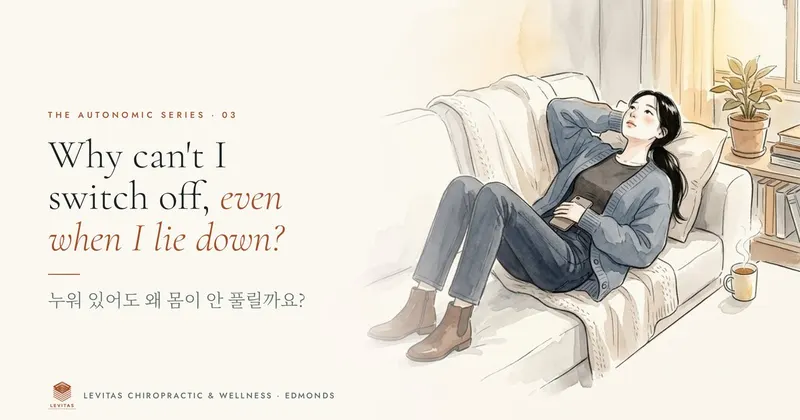
The dishes are done. You sink into the couch. Your body is still, but inside something keeps humming, like a car left idling in the driveway. You're resting. You're just not recovering.
설거지도 끝났고, 드디어 소파에 몸을 던졌어요. 몸은 가만히 있는데 속에서는 뭔가 계속 웅웅거려요. 시동을 안 끄고 세워 둔 차처럼요. 쉬고는 있는데, 회복은 안 되고 있는 거예요.
Part 2 was about alarm mode. This time it's the other half: rest mode, the parasympathetic nervous system, and the nerve that runs it, the vagus. It turns out the switch sits closer to the top of your neck than most people think.
2편이 비상 모드였다면, 이번엔 나머지 반쪽이에요. 휴식 모드인 부교감신경(parasympathetic nervous system)과, 이 모드를 움직이는 vagus nerve 이야기예요. 그 스위치는 생각보다 목 맨 위 가까이에 있어요.
Step 1 · Resting vs recovering
1단계 · 쉬는 것과 회복은 달라요
Resting isn't recovering.
Rest mode is the only time your body rebuilds. It slows your heart, sends blood to digestion, lets muscles repair and lets sleep go deep. Alarm mode gets you through today. Rest mode gets you ready for tomorrow.
몸이 회복하는 건 휴식 모드에 있을 때뿐이에요. 심장을 늦추고, 피를 소화 쪽으로 보내고, 근육을 회복시키고, 잠을 깊게 해요. 비상 모드가 오늘을 버티게 한다면, 휴식 모드는 내일을 준비하게 해요.
And it's never fully off. Left alone, your heart's built-in pacemaker would beat about 100 times a minute. Your resting pulse sits lower because the vagus nerve is quietly slowing it, every second of the day.
그리고 휴식 모드는 늘 조금은 켜져 있어요. 심장을 그냥 두면 자체 박자로 1분에 100번쯤 뛰어요. 쉴 때 맥박이 그보다 낮은 건, vagus nerve가 하루 종일 조용히 속도를 늦추고 있어서예요.
Key point: Lying still isn't rest. Your body has to shift into rest mode before it can recover.
핵심: 가만히 누워 있다고 쉬는 게 아니에요. 몸이 휴식 모드로 넘어가야 회복이 시작돼요.
Step 2 · The vagus nerve
2단계 · 주로 듣기만 하는 신경
It mostly listens.
"Vagus" is Latin for wandering, and it wanders far. Cranial nerve X leaves the skull behind your ear, runs down the neck beside the carotid artery, and reaches your heart, lungs and most of your gut.
vagus는 라틴어로 '떠돌이'라는 뜻인데, 정말 멀리 떠돌아요. cranial nerve X는 귀 뒤에서 두개골을 빠져나와 carotid artery 옆으로 목을 내려가고, 심장과 폐, 장 대부분까지 닿아요.
Here's the surprise. About 80% of its fibers carry news up, from your organs to your brain. It's less a remote control and more a phone line. Your heart, lungs and gut are constantly calling in, and your brain decides how calm it can afford to be.
놀라운 사실이 있어요. vagus nerve 섬유의 80% 정도는 장기에서 뇌로 소식을 올려 보내요. 리모컨이라기보다 전화선이에요. 심장과 폐, 장이 끊임없이 전화를 걸어오고, 뇌는 그걸 듣고 얼마나 마음 놓아도 되는지 정해요.
Key point: Your body talks to your brain through the vagus nerve. How you breathe and move is part of that conversation.
핵심: 몸은 vagus nerve로 뇌에 말을 걸어요. 어떻게 숨 쉬고 움직이느냐에 따라 뇌에 가는 이야기가 달라져요.
Step 3 · Both ends of the spine
3단계 · 척추 양 끝
Rest mode leaves from both ends.
Alarm mode lives in the middle of the spine, T1 to L2. Rest mode is the mirror image. Four cranial nerves carry it from the top: III narrows the pupils, VII keeps tears and saliva flowing, IX adds saliva, and X, the vagus, covers the heart, lungs and gut. At the bottom, the S2–S4 pelvic splanchnic nerves look after the lower colon, bladder and pelvic organs.
비상 모드 신경은 척추 가운데, T1에서 L2 사이에서 나와요. 휴식 모드는 그 반대예요. 위쪽은 cranial nerve 네 개가 맡아요. III은 눈동자를 작게, VII은 눈물과 침이 돌게, IX도 침을 보태고, X인 vagus nerve가 심장과 폐, 장을 맡아요. 아래쪽은 S2–S4의 pelvic splanchnic nerve가 대장 아래쪽, 방광, 골반 장기를 맡아요.
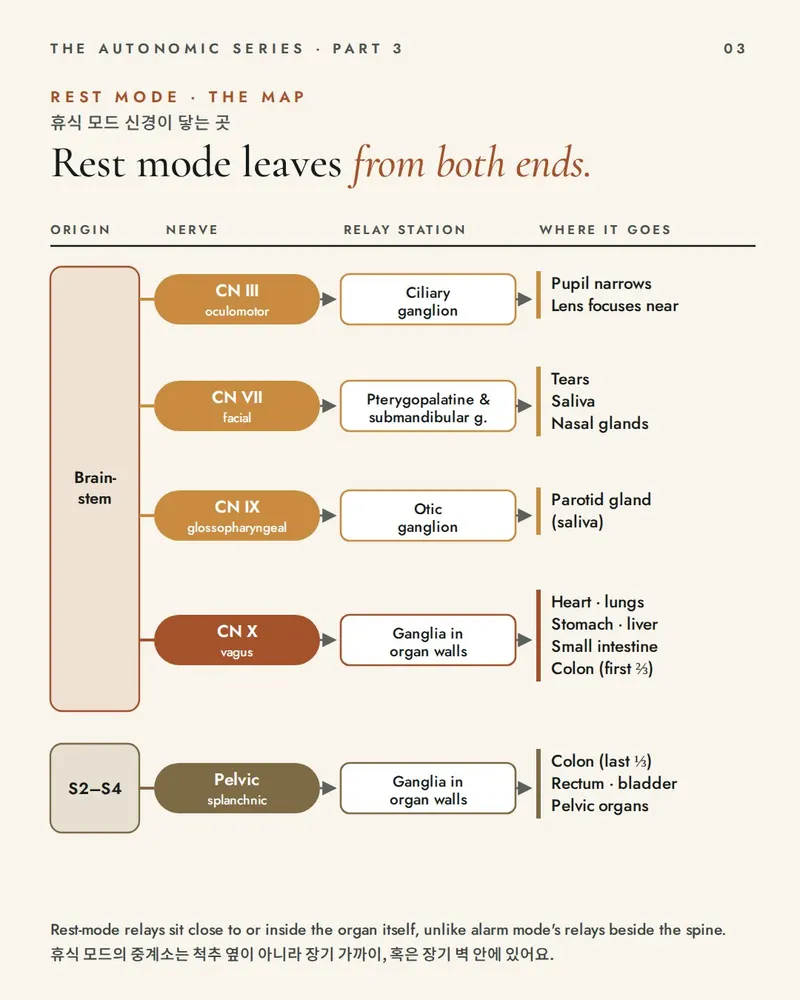
Key point: Alarm mode lives in the middle. Rest mode lives at the base of the skull and the sacrum.
핵심: 비상 모드 신경은 척추 가운데서, 휴식 모드 신경은 두개골 아래와 천골에서 나와요.
Step 4 · The top of your neck
4단계 · 목 맨 위
Small joints, big job.
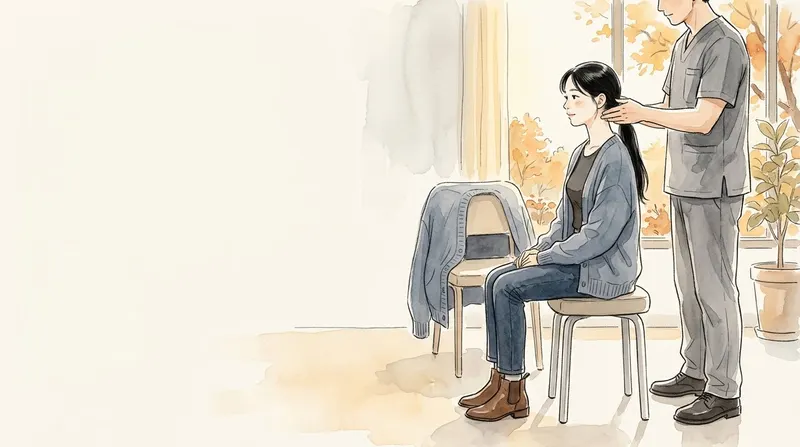
Two tiny joints do an outsized share of your neck's work. The joint between your skull and C1 handles much of your "yes" nod. The joint between C1 and C2 handles about half of all the turning your neck does. Every shoulder check while driving and every glance down at your phone happens mostly right here.
아주 작은 관절 두 개가 목이 하는 일의 큰 몫을 맡아요. 두개골과 C1 사이 관절은 "네" 하고 끄덕이는 움직임의 상당 부분을, C1과 C2 사이 관절은 목이 돌아가는 움직임의 절반쯤을 혼자 해내요. 운전하다 고개를 돌릴 때도, 휴대폰을 내려다볼 때도, 대부분 바로 여기서 움직여요.
And C1 lives in a crowded neighborhood. Right in front of its side wings, the transverse processes, run four cranial nerves, IX, X, XI and XII, along with the internal jugular vein. Surgeons use that spot as a landmark because there's so little spare room. In some people, imaging has even shown C1 and a nearby bony spur narrowing the jugular vein, the vessel that runs right beside the vagus.
게다가 C1 주변은 빈틈이 거의 없어요. 양옆 날개(transverse process) 바로 앞으로 cranial nerve IX, X, XI, XII 네 개와 internal jugular vein이 함께 지나가요. 워낙 빽빽해서 외과의들이 수술할 때 길잡이로 삼는 자리예요. 일부 사람들에게서는 C1과 근처 뾰족한 뼈가 jugular vein을 좁히는 모습이 영상으로 확인되기도 했어요. vagus nerve 바로 옆을 나란히 지나가는 혈관이에요.
Does a rotated C1 press on the vagus itself? That hasn't been shown directly in studies, and we'd rather say so than overpromise. What is clear is that the small muscles under your skull are packed with position sensors, among the densest anywhere in the body. When the top of the neck stops moving well, those sensors send a different report, and it lands right beside the brainstem, where the vagus nerve's control centers sit.
그럼 돌아간 C1이 vagus nerve 자체를 누를까요? 그건 아직 연구로 직접 확인되지 않았어요. 부풀리기보다 그렇게 말씀드리는 게 맞아요. 분명한 건, 두개골 바로 아래 작은 근육들에 위치 센서가 몸 전체에서 손꼽힐 만큼 빽빽하다는 거예요. 목 맨 위가 제대로 안 움직이면 이 센서들의 보고가 달라지고, 그 보고는 vagus nerve의 조절 중추가 모인 brainstem 바로 옆으로 들어가요.
Key point: The skull, C1 and C2 do much of your nodding and turning, sit beside the vagus nerve, and report straight to the brainstem. That's why a chiropractor looks here first.
핵심: 두개골, C1, C2는 끄덕임과 돌림의 큰 몫을 맡고, vagus nerve 곁에 있고, brainstem에 곧장 보고해요. 카이로프랙터가 이곳부터 보는 이유예요.
Step 5 · What we actually do
5단계 · 저희가 실제로 하는 일
We clear the path.
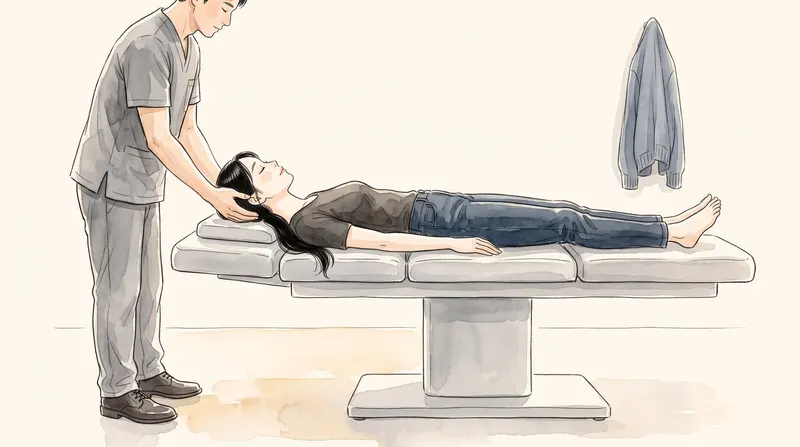
We look at how your head sits on C1, how C1 turns on C2, and whether the nod and the turn are even side to side. If a joint is stuck, an adjustment gives it its motion back. Then we check the other end, the sacrum, and the middle, where the alarm lives.
머리가 C1 위에 어떻게 얹혀 있는지, C1이 C2 위에서 어떻게 도는지, 끄덕임과 돌림이 좌우로 고른지 봐요. 걸린 관절이 있으면 교정으로 움직임을 돌려드려요. 그다음 반대쪽 끝인 천골과, 비상 모드 신경이 나오는 가운데도 같이 봐요.
One small study found that upper-neck adjustments shifted heart rhythms toward rest mode in people with neck pain. Other trials haven't found the same, and the effects that do show up are short-term. So we won't promise to switch rest mode on for you. We clear what keeps the alarm on, the pain and the stuck joints, so your body can find its own way there.
목 위쪽 교정 뒤에 목 통증 환자들의 심박 리듬이 휴식 모드 쪽으로 움직였다는 작은 연구가 있어요. 같은 결과가 안 나온 연구도 있고, 나타난 효과도 대개 짧게 이어져요. 그래서 휴식 모드를 켜 드린다고 약속하진 않아요. 비상벨을 켜 두는 것들, 통증과 걸린 관절을 치워서 몸이 스스로 휴식 모드로 넘어가게 해요.
Key point: We don't flip a switch. We clear the path.
핵심: 스위치를 켜 드리는 게 아니라, 길을 터 드려요.
Step 6 · Try it tonight
6단계 · 오늘 밤 해 보세요
In for four, out for six.
A healthy heart isn't a metronome. It speeds up a little as you breathe in and slows as you breathe out. That slowing is the vagus nerve at work, and the beat-to-beat difference is called heart rate variability, or HRV. If you wear a smartwatch, you may already be tracking it. Stress, poor sleep and ongoing pain tend to flatten it.
건강한 심장은 메트로놈이 아니에요. 들이쉴 때 살짝 빨라지고, 내쉴 때 느려져요. 그 느려짐이 vagus nerve가 일하는 모습이고, 박동 간격이 달라지는 걸 심박변이도, heart rate variability(HRV)라고 해요. 스마트워치를 차고 계시면 이미 재고 계실지도 몰라요. 스트레스, 잠 부족, 계속되는 통증은 이 차이를 줄여 놓아요.
So give the vagus more out-breath to work with. Breathe in through your nose for four, and out through your mouth for six. That's about six breaths a minute. Keep going for five minutes. Across dozens of studies, slow breathing like this raised the rest-mode side of HRV while people did it. It won't undo a hard week. It does remind your body the way back.
그러니 내쉬는 숨을 길게 늘려 보세요. vagus nerve가 일할 시간이 늘어나요. 코로 넷 세며 들이쉬고, 입으로 여섯 세며 내쉬어요. 1분에 여섯 번쯤이에요. 5분만 이어 가요. 수십 편의 연구를 모아 보니, 이렇게 천천히 숨 쉬는 동안 HRV의 휴식 모드 지표가 올라갔어요. 힘든 한 주를 지워 주진 않아요. 그래도 몸이 쉬는 법을 다시 떠올리게 해 줘요.
"I rest, but I never feel rested." I hear it all the time. Rest mode isn't something you can force. Your body slips into it once nothing is pulling the alarm. If your neck, your low back or your sleep keeps getting in the way, come in and we'll look at the whole picture together. Clothes you can move in are all you need.
"쉬는데도 쉰 것 같지가 않아요." 진료실에서 정말 자주 듣는 말이에요. 휴식 모드는 억지로 켜는 게 아니에요. 비상벨을 울리는 게 사라지면 몸이 알아서 넘어가요. 목이나 허리, 혹은 잠이 자꾸 발목을 잡는다면 한번 들러 주세요. 몸 전체를 같이 살펴봐요. 편하게 움직일 수 있는 옷이면 충분해요.
This series
이 시리즈 · 자율신경계
Part 1 Why Am I This Tired When I Haven't Done Anything? · 한 것도 없는데 왜 이렇게 지칠까요?
Part 2 Why Do My Hands Go Cold When I'm Stressed? · 스트레스 받으면 왜 손이 차가워질까요?
Part 3 Why Can't I Switch Off, Even When I Finally Lie Down? · 누워 있어도 왜 몸이 안 풀릴까요? (현재 글)
Levitas Chiropractic & Wellness
23700 Edmonds Way, Edmonds, WA 98026
levitaschiropractic.com · KakaoTalk 리비타스 카이로프락틱
We see patients in English and Korean. We accept PIP (auto injury), L&I (work injury), and cash pay.
한국어와 영어로 진료합니다. 자동차 사고(PIP), 산업재해(L&I), 현금 진료를 받습니다.
Book a visit · 예약하기
Kilbo Yun, D.C.
Doctor of Chiropractic
This article is general health information and does not replace individual diagnosis or treatment.
이 글은 일반적인 건강 정보이며 개별 진단이나 치료를 대신하지 않습니다.
References
McCorry LK. Physiology of the autonomic nervous system. Am J Pharm Educ. 2007;71(4):78.
Wehrwein EA, Orer HS, Barman SM. Overview of the anatomy, physiology, and pharmacology of the autonomic nervous system. Compr Physiol. 2016;6(3):1239–1278.
Gordan R, Gwathmey JK, Xie LH. Autonomic and endocrine control of cardiovascular function. World J Cardiol. 2015;7(4):204–214.
Berthoud HR, Neuhuber WL. Functional and chemical anatomy of the afferent vagal system. Auton Neurosci. 2000;85(1–3):1–17.
Bogduk N, Mercer S. Biomechanics of the cervical spine. I: Normal kinematics. Clin Biomech. 2000;15(9):633–648.
Sheen TS, Chung TT, Snyderman CH. Transverse process of the atlas (C1). Head Neck. 1997;19(1):37–43.
Dincă D, et al. Anatomical reasons for an impaired internal jugular flow. Medicina. 2025;61(9):1627.
Kulkarni V, Chandy MJ, Babu KS. Quantitative study of muscle spindles in suboccipital muscles of human foetuses. Neurol India. 2001;49(4):355–359.
Win NN, et al. Effects of upper and lower cervical spinal manipulative therapy on blood pressure and heart rate variability. J Chiropr Med. 2015;14(1):1–9.
Picchiottino M, et al. The acute effects of joint manipulative techniques on markers of autonomic nervous system activity. Chiropr Man Therap. 2019;27:17.
Shaffer F, Ginsberg JP. An overview of heart rate variability metrics and norms. Front Public Health. 2017;5:258.
Laborde S, et al. Effects of voluntary slow breathing on heart rate and heart rate variability. Neurosci Biobehav Rev. 2022;138:104711.
View the full brochure · 브로셔 전체 보기